What Is the Best Drone Hardware for Construction Sites?
Last Updated: November 16, 2026
Quick Summary
The best drone hardware for construction sites depends on your primary job, not the biggest spec sheet: the DJI Mavic 3 Enterprise is the most common starting point for contractors doing recurring progress documentation, while the DJI Matrice 350 RTK, Skydio X10, and WingtraOne serve survey teams, autonomous workflows, and photogrammetry. Match the airframe to inspections, mapping, progress tracking, or thermal work before buying.
- The Mavic 3 Enterprise is described as offering 1-centimeter accuracy with its RTK module, a manufacturer-class claim.
- RTK-equipped platforms correct position in real time, which can reduce the ground control points you need to place.
- For progress tracking, consistent flight paths and framing matter more than the highest resolution.
- Thermal is worth the cost for moisture, insulation, and electrical issues, but interpretation is a skill.
- Two or more no answers on the purchase checklist point toward booking a flight crew instead.
Table of Contents
- What Construction Drone Hardware Actually Delivers on Site
- Quick Comparison: Best Drone Hardware for Construction Sites
- Which Is the Best Drone for Building Inspections?
- Drone Construction Mapping: RTK, Photogrammetry, and What to Buy
- Choosing a Drone Camera for Construction Progress Tracking
- Do You Need a Thermal Drone for Construction Inspections?
- Buying Hardware or Booking a Flight Crew: Which Fits Your Project?
- Get a Free Aerial Consultation Before You Buy
- Frequently Asked Questions
What Construction Drone Hardware Actually Delivers on Site
Construction drone hardware is the combination of aircraft, camera payload, and positioning equipment used to capture aerial site data for progress documentation, mapping, and inspection. The payoff is real: the global construction drone market is projected to reach $11.96 billion by 2027, according to UAV Coach's construction drone guide, and 36.1% of surveyed industry respondents already fly drones on their projects, per DroneTrader's construction drone buyer's guide.
The hardware captures images and coordinates; the workflow turns them into something a project manager can act on. Buy the wrong airframe for your use case and you will spend more time managing files than managing the build.
Below, we break down the best drone hardware for construction sites by job: inspections, mapping, progress tracking, and thermal work. We also cover when buying makes sense and when booking a flight crew is the smarter call.
Quick Comparison: Best Drone Hardware for Construction Sites
The best drone hardware for construction sites depends on your primary job, not the spec sheet with the biggest numbers. Here is how the leading platforms stack up.
| Drone | Positioning | Camera | Best For | Pricing |
|---|---|---|---|---|
| DJI Mavic 3 Enterprise | RTK module support | 4/3-inch sensor | Recurring progress documentation | Contact for pricing |
| DJI Matrice 350 RTK | RTK platform | Payload-dependent | Survey teams, payload flexibility | Contact for pricing |
| Skydio X10 | Autonomous workflows | Not verified in research | Mapping, progress tracking | Contact for pricing |
| WingtraOne | GNSS correction | Survey-grade | Aerial survey and photogrammetry | Contact for pricing |
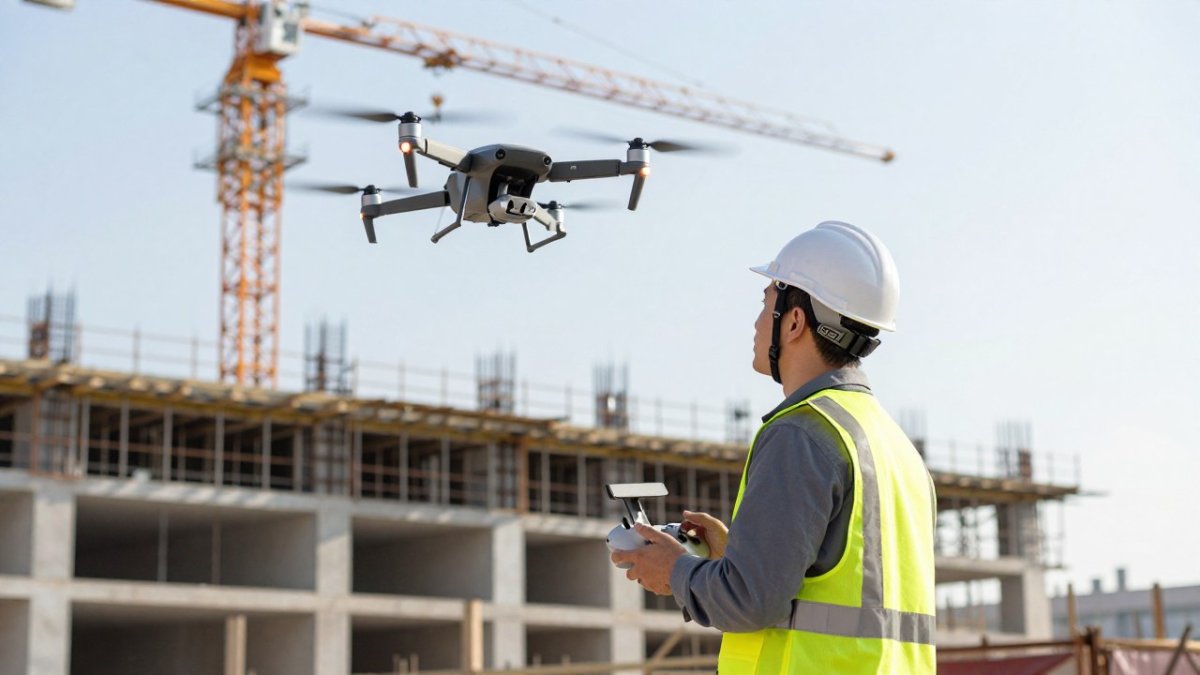
The Mavic 3 Enterprise is the most common starting point for contractors. A product roundup from Drone Doctor's construction drone picks describes it as offering 1-centimeter accuracy with its RTK module, though the source does not detail how that accuracy was measured. Treat that figure as a manufacturer-class claim, not an independent test result.
Which Is the Best Drone for Building Inspections?
A compact platform with a high-resolution camera and stable hover suits building inspections.
If you would rather not buy at all, book an aerial inspection and see the output before you spend on hardware.
Drone Construction Mapping: RTK, Photogrammetry, and What to Buy
Drone construction mapping is the process of flying a programmed grid over a site and converting overlapping photos into orthomosaics, point clouds, and surface models. Accuracy hinges on one thing: ground control.
RTK-equipped platforms correct position in real time, which can reduce the ground control points you need to place.
What most guides miss is the processing side. The airframe is half the purchase; the software subscription and the person who can read a point cloud are the other half. A common mistake is buying survey-grade hardware without anyone on staff trained to process the data.
For infrastructure examples that show this work in practice, review our project work.
Choosing a Drone Camera for Construction Progress Tracking
A drone camera for construction progress tracking needs repeatability more than raw megapixels. You want the same flight path, the same altitude, and the same framing every week so two dates can be compared side by side.
Consistent, comparable images matter more than the highest resolution for progress monitoring.
Three specs that actually matter:
- Sensor size: a larger sensor holds detail in shadowed interiors and steel framing.
- Mechanical shutter: reduces rolling-shutter distortion on fast mapping passes.
- Gimbal stability: consistent framing across flights is what makes week-over-week comparison possible.
Do You Need a Thermal Drone for Construction Inspections?
A thermal drone for construction inspections is worth the cost when you need to find moisture intrusion, insulation gaps, or electrical hot spots that a visual camera cannot see. For routine progress photos, thermal adds cost without adding much.
The honest limitation: thermal interpretation is a skill. A hot spot on a roof could be a failing membrane or solar gain, and reading it wrong sends a crew on a wasted repair. Radiometric payloads and trained analysts matter more than the airframe here.
Our thermography service covers thermal drone work. If thermal is a once-a-quarter need, booking beats buying.
Buying Hardware or Booking a Flight Crew: Which Fits Your Project?
Buying hardware wins when you fly weekly, need data on demand, and have someone to process it. Booking a flight crew wins when your needs are periodic, specialized, or too varied for one airframe to cover.
Run this checklist before you write a purchase order:
- Do you need aerial data at least twice a month?
- Is there a trained pilot and processor on staff?
- Can you absorb software subscriptions and insurance?
- Is your use case consistent enough for one platform?
- Have you compared the annual cost against per-project flights?
Two or more "no" answers point toward booking. A small contractor with three or four projects a year rarely justifies a five-figure hardware stack plus training. The math favors a flight crew almost every time.
Get a Free Aerial Consultation Before You Buy
The best drone hardware for construction sites is the hardware that matches your actual workflow, and that decision is easier with aerial data in hand. Before you commit to an airframe, see what the output looks like on your own site.
Airborne Assets LLC provides professional aerial photography and videography for construction, real estate, and inspections. We offer a free consultation, so you can discuss your documentation needs before spending on equipment.
Get started with Airborne Assets LLC and see your site from above before you buy. Let's talk about your next project.
The hardware decision comes down to frequency and workflow fit, not the longest spec sheet. If your projects are periodic, start with a booked flight and let the deliverables make the case.
Frequently Asked Questions
How much does a drone inspection cost?
Pricing depends on the size of the structure, the number of flights, and the deliverable you need, so no single figure fits every project. A single-family roof inspection and a multi-building site survey are different jobs with different flight times and processing needs. Ask for a quote that lists the number of flights, image resolution, and whether you receive raw files or an edited report. Clear Focus Imaging offers a free consultation so you can scope the work before committing to a price.
What drone features matter most for construction site inspections?
Prioritize RTK positioning for accurate mapping, a camera with a large sensor for detail in shadows and bright sun, and reliable battery life for covering a full site in one visit. Obstacle avoidance matters on crowded sites with cranes and scaffolding. Repeatable flight paths and consistent image capture count as much as raw camera specs. Thermal capability is worth adding only if you need moisture or heat detection.
Do construction drones need thermal cameras?
Only if your work involves finding moisture intrusion, insulation gaps, electrical hot spots, or roof leaks that visual cameras miss. A thermal drone for construction inspections adds cost and complexity, and the images require interpretation. If your primary need is progress documentation and mapping, a standard RGB camera with RTK support covers it. Many teams start with a visual platform and rent or book thermal flights when a specific diagnostic question comes up.
Can you do roof inspections with a drone?
A drone with a high-resolution camera can capture roof surfaces and flashing details without anyone climbing a ladder. Thermal sensors can add value for finding moisture behind the roof deck.

